You're not in this by yourself: Andrew Grist on rural financial counselling support
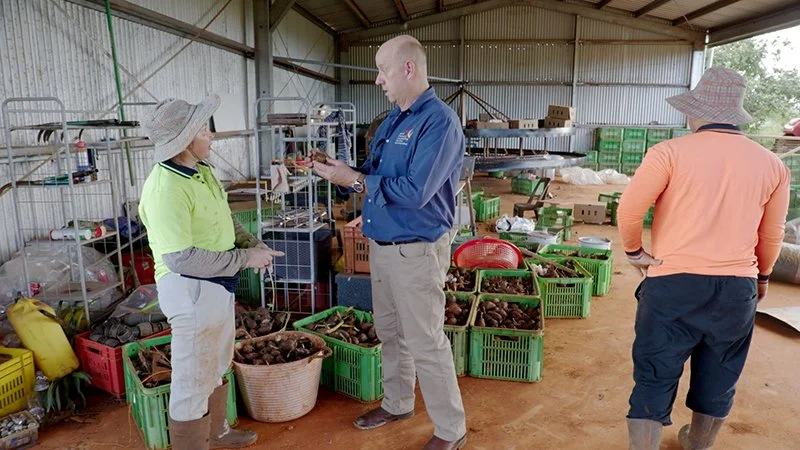
Andrew worked to make sure the family understood everything available to them.
Andrew Grist is one of the dedicated Rural Financial Counsellors, funded by the Australian and Queensland Governments under the Disaster Recovery Funding Arrangements following Cyclone Jasper - helping producers get back on their feet and plan for a more resilient future.
Andrew Grist has been a Rural Financial Counsellor for nineteen years, and is currently based on the Cassowary Coast. With a background that includes running his own farming enterprises and as a CPA he knows how hard, and how many things can be outside your control as a producer – including those who faced Cyclone Jasper.
“Cyclone Jasper was the wettest tropical cyclone in Australian history,” Andrew said. “It not only devastated crops and equipment, there was continual rainfall for many months after that.”
For many farmers, the flow-on effect was brutal: crops that should have delivered income were delayed by the ongoing wet, pushing some recoveries out to eighteen months. “The ability to get back into the paddock and prepare the crop for your income was significantly delayed.”
Beyond the direct damage, the disaster created a secondary squeeze: everyone needed help at once. “There's the demand on local contractors and expertise. There's significant delays in machinery fixing, getting the right people on board,” Andrew said.
“So, it's a whole world of hurt for farmers, not only losing their income and surviving that, but also being able to fund and get the people in time.”
That's where government support, and the Rural Financial Counselling Service North Queensland, made the difference.
“The funding that was extremely welcomed was the disaster relief, the grants that enabled them to get their tractors fixed, get their on-farm infrastructure fixed,” Andrew said, pointing also to disaster loans and federal concessional loans and income support already in place for the sector.
“The Australian and Queensland governments are very supportive of the agricultural sector. So, make sure you contact and make sure you're aware of what's around.”
Andrew's role goes well beyond pointing people to funding. “The beauty of RFCs is we're free and confidential. We're local and on the ground as a service regardless of a natural disaster,” he said.
That means working through cash flow, debt, conversations with the ATO and the banks, and helping business owners prioritise their resources when everything feels urgent at once.
Andrew is careful to point out that a disaster rarely stays contained to the business itself. “Not only do you see your business devastated, it's your home, it's everything you work for,” he said.
“So the emotional and the amount of stress that you're under is enormous.” For many of the farmers Andrew works with, that means navigating financial recovery and a genuine personal crisis at the same time, in a period he describes simply as a “world of hurt from every angle.”
That's where the service's wraparound model comes in. Alongside his own role, Andrew can draw on the Small Business Financial Counsellors and Business Wellbeing Coaches in his team, referring people on to whichever kind of help best fits what they're going through.
“I suppose our strength is to try and help you navigate a way forward and to rebuild. That can be dealing with banks, or getting some cash flow relief. It can be sort of prioritising your resources, and assisting you to be in a space where you can make the best decisions around moving forward from such a devastating event.”
Andrew's approach is to bring calm and structure to that chaos, in the short and longer-term. “What we're trying to do is have some sort of calm and control about the business that's devastated, and work in a rational, logical way on how to rebuild and get back on your feet,” he said.
He's also realistic that disasters on the Cassowary Coast aren't a one-off risk. He suggests using the quieter periods to prepare: reducing debt, looking into farm management deposits, building cash reserves, so the next event is easier to weather.
After nineteen years supporting farmers through exactly this kind of crisis, Andrew's message is simple whether is preparing for the future or facing disaster recovery. “The knowledge and understanding of the support from the Australian and Queensland governments is crucial, that people are aware that you're not in this by yourself,” he said.
“If this happens to you, please don't hesitate to reach out. We are free and confidential... you'll be surprised what's around, and what can make the difference.”
Assistance provided through the jointly funded Commonwealth-state Disaster Recovery Funding Arrangements (DRFA).