Back to the land: how a family rebuilt their farming enterprise after Cyclone Jasper
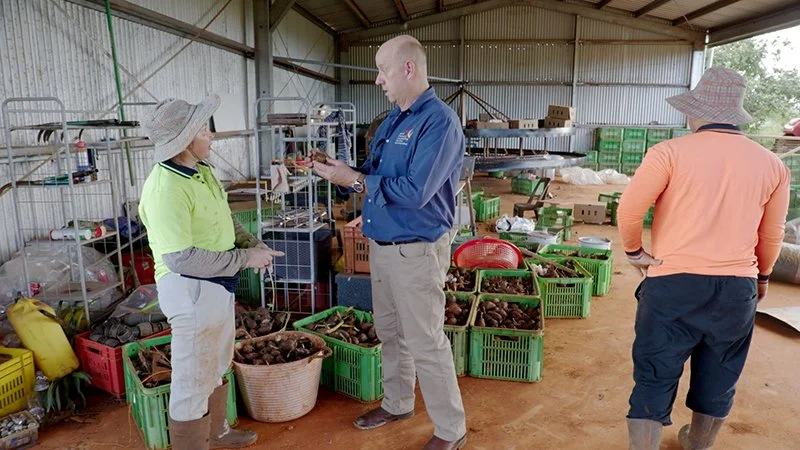
Mei and Kee valued the support from Andrew to help prepare the applications and understand recovery support processes.
The Vang family is one of many rural business owners across the Cyclone Jasper impacted region to have accessed support from the Rural Financial Counselling Service North Queensland, funded by the Australian and Queensland Governments under the Disaster Recovery Funding Arrangements - helping farming families like theirs get back on their feet and grow back stronger.
On their family farm on the Cassowary Coast, Mei Vang works alongside her family including son Kee, growing a variety of crops including taro, cassava, purple yam and turmeric. The family farmed in Laos before life in Australia took them into other work for a time, until 2018, when farming drew them back. "We've come back to farming because that's something that is in our culture – we love farming," Kee said. Three generations now depend on the farm: Kee's parents, Kee and his siblings, and their children.
Taro is the heart of the operation. "The taro is the big market and the main income, that's why we still grow taro," Mei said, cassava and turmeric are too small a market to carry the farm on their own.
Growing taro is demanding work, reliant on the weather and largely done by hand. "The only thing that's done with the tractor is just getting the land ready. But when it comes to planting and harvesting, it's all done by hand," Kee said.
Cyclone Jasper hit paddocks the family had spent years building up. "We spent a lot of time, a lot of money, a lot of fertiliser bringing it up to where it was. But when the cyclone came, it took all of it away," Kee said. "It just knocked it all down flat... it was devastating." Flooding destroyed the ground they'd planted, and sudden, heavy rain sent the river over their water pumps.
"It also destroyed all our water pumps. We didn't have time to go get them, and they were all submerged for about two weeks." By the time the water receded, the family had lost their pumps, their tractors, and the entire year's taro crop. "All the tractors had broken with the water damage, all the water pump is damaged," Mei said. "The income stopping, but you still had to fix the tractor and fix the water pump. That's very hard and painful for the farmer."
It took the family ten to eleven months from planting to harvest of a new taro crop, and a further six to seven months before that crop began bringing in income again.
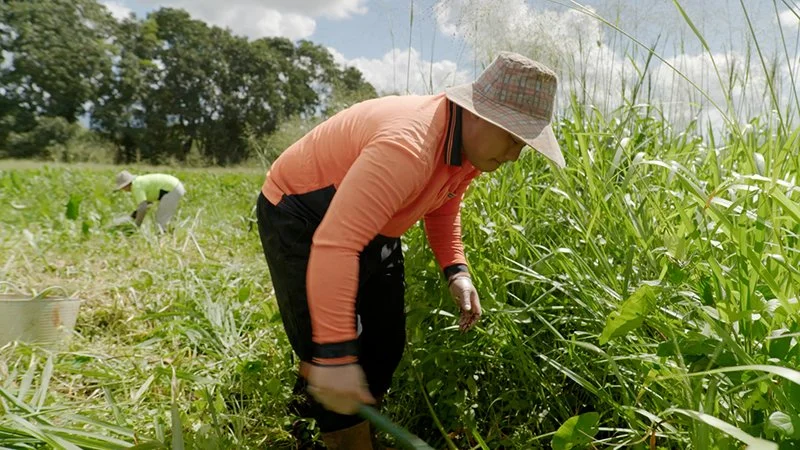
Growing taro is demanding work, reliant on the weather and largely done by hand.
Grants, accessed with support from Rural Financial Counsellor Andrew Grist, helped repair the tractors and restore the water pumps, without which replanting couldn't begin at all. "The benefits from the government support, it's helping us get back on our feet after a disaster like that, just so that we can replant the crops that we've lost," Kee said.
Andrew's support went well beyond the paperwork itself.
Mei, who says she struggles to read and write in English, valued the support from Andrew to help prepare the application. "Andrew helping me to do all the application, especially me, I cannot reading, cannot writing," she said. "You're helping me a lot to get the funding from the government, for tractor and water pump."
Kee agrees. "The way you supported us, with the language barrier with my mum, and with us, the stress on the farm. You've helped us run paperwork that we wouldn't have had time to look through carefully, and gone through it properly. You've taken your own time to really, really fight for that chance for us to get that funding."
That support is something the family has since passed on. Innisfail's Laos community includes around 30 farming families, and word travels. "We have a community here that really support each other," Kee said, and Mei has made sure others facing the same hardship know where to turn. "I do tell the family, and others who had the same problem as me, I'm passing Andrew to everyone to get that helping."
For Mei, words haven't quite been enough to capture what that support has meant. "You did more than that," she said. "I can't find the word how much you help."
Assistance provided through the jointly funded Commonwealth-state Disaster Recovery Funding Arrangements (DRFA).